Freud's Hysteria
Part of the history of psychologizing physical illness

.jpg)
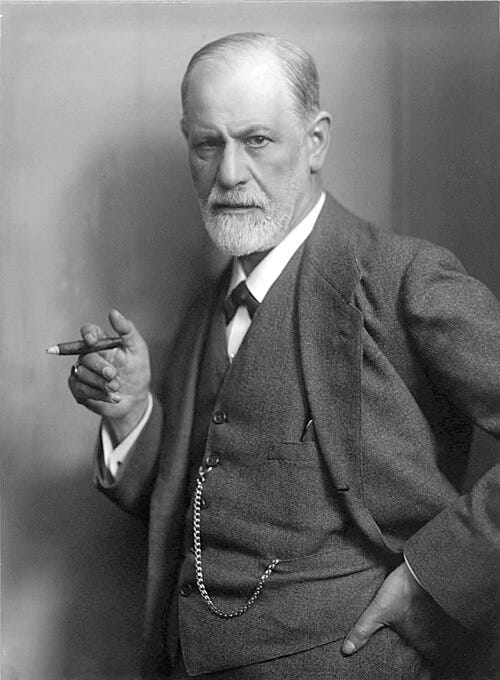
Sigmund Freud (1856–1939) is known as the father of psychotherapy, and one of the founders of modern psychology. He created and popularized the idea that unconscious thoughts, feelings and memories can profoundly impact a person.
The notion of an illness called ‘hysteria’ affecting women had been around since ancient times, but Freud created his own version of it. In Freud’s hysteria, both psychological symptoms (such as excessive fear or nervousness) and physical symptoms (such as tremors, headaches, or unusual fatigue) could be caused by repressed emotional traumas, which the patient might not even be aware of.
According to Freud, both men and women could suffer from hysteria, but it was far more common among women.
Freud’s way of working was not what we would recognize as ‘scientific’. He didn’t carry out scientific experiments to test his theories. Instead, he had long sessions with his clients, during which he used techniques such as free association and dream analysis. Nevertheless, his ideas were widely accepted.
We have no way of knowing how often physical disease was misdiagnosed as hysteria. There are records from the early twentieth century showing patients diagnosed with hysteria, who later turned out to have multiple sclerosis (MS). The fluctuating nature of MS symptoms was (wrongly) taken as evidence that the illness was psychological.
Hysteria was treated as a valid medical diagnosis for most of the twentieth century. ‘Hysterical neurosis’ was included in the 1974 Diagnostic and Statistical Manual (DSM-2), but was removed in the 1980 DSM-3.
However, it could be argued that hysteria didn’t really disappear, it just got rebranded as ‘conversion disorder’, which did appear in the DSM-3 and DSM-4. In the 2013 DSM-5 conversion disorder was removed, and replaced with functional neurological disorder (FND).
The connection between hysteria and FND is controversial. Some people insist that FND has evolved so far that it no longer bears any resemblance to the old, sexist, and unscientific idea of hysteria. However, others believe that FND is just hysteria, rebranded.
References and further reading
The History of Hysteria, Ada McVean, 31 Jul 2017, accessed 9 March 2026
The dark psychosomatic history of multiple sclerosis, by ME/CFS Science, 18 March 2021, accessed 9 March 2026
Sigmund Freud, Wikipedia
Conversion disorder, Wikipedia
Anthony Feinstein, Conversion disorder: advances in our understanding, CMAJ May 17, 2011 183 (8) 915-920; DOI: https://doi.org/10.1503/cmaj.110490. Available at https://www.cmaj.ca/content/183/8/915
Madva EN, Ross DA, Cooper JJ. What’s All the Hysteria About? A Modern Perspective on Functional Neurological Disorders. Biol Psychiatry. 2019 Jan 15;85(2):e3-e4. doi: 10.1016/j.biopsych.2018.11.003. Erratum in: Biol Psychiatry. 2019 Mar 1;85(5):434. doi: 10.1016/j.biopsych.2019.01.005. PMID: 30573052; PMCID: PMC6444349. Available at https://pmc.ncbi.nlm.nih.gov/articles/PMC6444349/
Chaudhry HR, Arshad N, Niaz S, Cheema FA, Iqbal MM, Mufti KA. Fifteen-year follow-up of conversion disorder. Int Psychiatry. 2005 Oct 1;2(10):17-19. PMID: 31507790; PMCID: PMC6733134. Available at https://pmc.ncbi.nlm.nih.gov/articles/PMC6733134/
are we allowed to share your blogs and include them off and on in the ME Global Chronicle https://wordpress.com/home/meglobalchronicle.wordpress.com of course always mentioning their source? As also translate them into Dutch for the Dutch ME-community (to be published at ME Centraal https://mecentraal.wordpress.com/) ?
Unfortunately that concept has made a comeback, just as neurologists were successfully fighting it. https://drsullins.substack.com/p/not-hysterical-just-regretful